The Action Research Arm Test.
One of the most widely used standardized measures of upper-extremity function in neurorehabilitation — now available direct from Salia Rehab.
Lowest price guaranteed
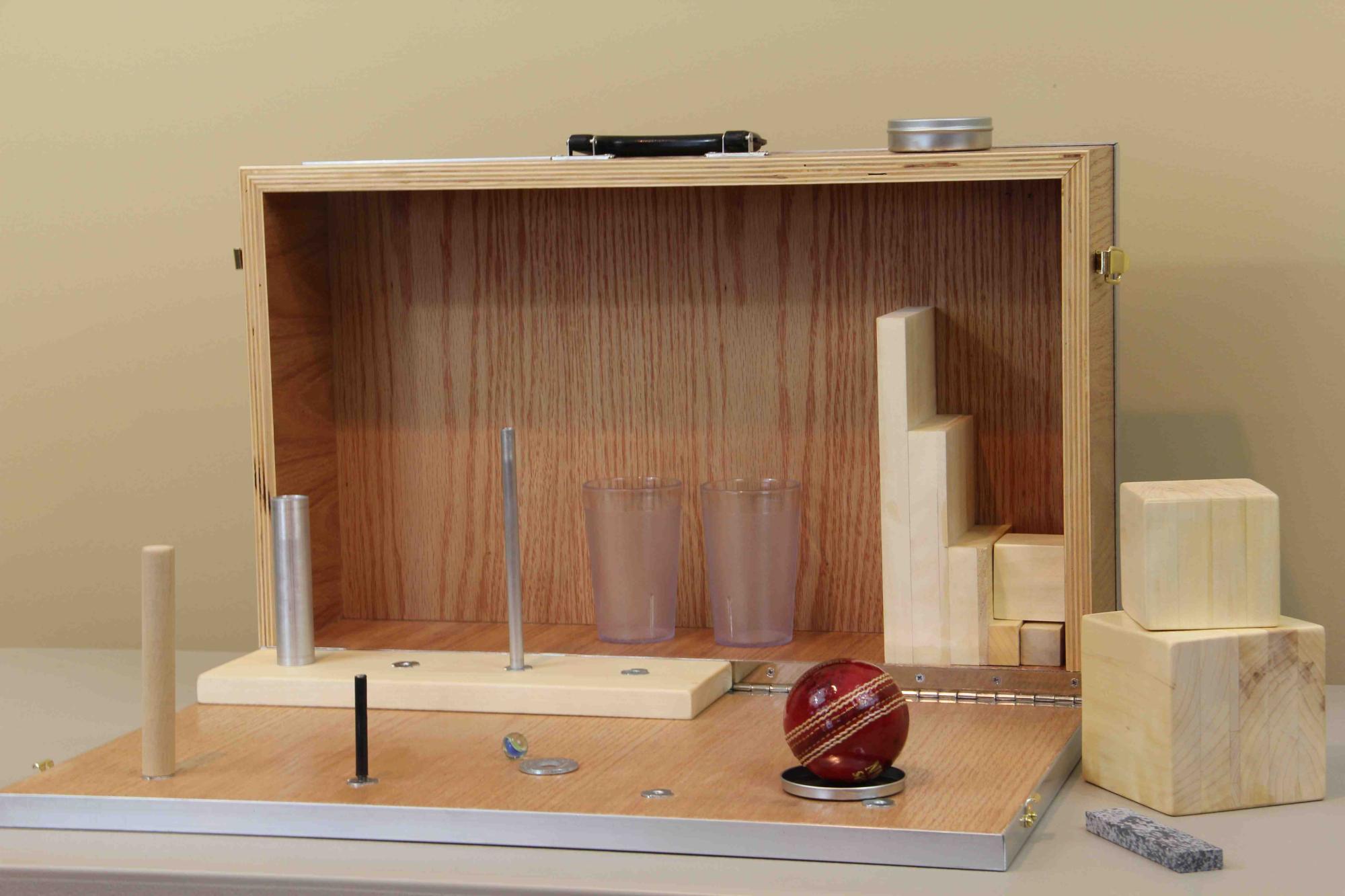
An evaluative measure with 40+ years of clinical validation.
The ARAT assesses specific changes in limb function among individuals who have sustained cortical damage resulting in hemiplegia. Developed by Ronald Lyle in 1981, it remains one of the most reliable and valid upper-extremity measures in the field.
It evaluates a client's ability to handle objects differing in size, weight, and shape — making it an arm-specific measure of activity limitation (Platz, Pinkowski, Kim, di Bella, & Johnson, 2005).
19 items. 4 subtests. A single ordinal scale.
All items are rated on a 4-point ordinal scale — from 0 (no movement possible) to 3 (normal performance). Total scores range from 0 to 57, with higher scores indicating better function. Time limits are built in to facilitate scoring (Yozbatiran et al., 2008).
Grasp
Lift and manipulate blocks and objects of varying size.
Grip
Pour and transfer using jars, tubes, and cylinders.
Pinch
Precision handling of ball bearings and marbles.
Gross Movement
Hand-to-mouth, head, and behind-the-head motions.
How the ARAT is scored and administered.
The 4-point scale
Every one of the 19 items is scored by direct observation on the same 4-point ordinal scale:
- 3Performs the test normally.
- 2Completes the test, but takes abnormally long or has great difficulty.
- 1Performs the test partially.
- 0Can perform no part of the test.
Item scores are summed for a total between 0 and 57. A higher score indicates better upper-limb function.
Lyle's decision rules
Each subtest is hierarchical (a Guttman scale), so most patients are not asked to complete every item:
- The first item of a subtest is the most difficult. If the patient scores 3, they are credited with a 3 on every remaining item of that subtest.
- If they score less than 3 on the first item, the second item — the easiest — is administered.
- If they score 0 on that easiest item, they are credited with 0 for the remaining items of the subtest.
- Otherwise, the remaining items of the subtest are administered in order.
Who can administer it?
The ARAT is an observer-rated, paper-and-pencil measure typically administered by occupational therapists, physical therapists, and clinical researchers. No formal certification is required, but raters should follow a standardized protocol to keep scores comparable over time and across sites.
Is training required?
Training is strongly recommended rather than mandated. Yozbatiran, Der-Yeghiaian, and Cramer (2008) published a detailed standardized administration and scoring manual after finding that consistent procedures produce excellent intra-rater and inter-rater reliability.
Who is it used with?
It was developed for adults with cortical damage resulting in hemiplegia and is most often used in stroke recovery. It is also applied in brain injury recovery and multiple sclerosis populations.
Sources: Lyle, R. (1981); Carroll, D. (1965) Upper Extremity Function Test; Yozbatiran, N., Der-Yeghiaian, L., & Cramer, S.C. (2008), A Standardized Approach to Performing the Action Research Arm Test, Neurorehabilitation and Neural Repair; Shirley Ryan AbilityLab Rehabilitation Measures Database.
Everything you need to assess, plan, and prove progress.
Analyze Functional Ability
Objectively evaluate a patient's upper-extremity function across grasp, grip, pinch, and gross movement.
Customize Treatment Plans
Use scored subtests to target the specific movement deficits driving activity limitation.
Measure Progress Over Time
Track meaningful change with a 0–57 scale trusted in clinical research for over 40 years.
Standardized & Portable
A single, self-contained wooden test kit — the same protocol used by leading neuro programs worldwide.
A closer look at the ARAT kit.
Once a shipment leaves the United States and is transferred to the destination country's carrier, we are no longer responsible for delivery, delays, customs processing, or final receipt. Customers are responsible for ensuring accurate address information and coordinating with their local carrier as needed.
All sales are final. Returns or refunds are not accepted.
Ready to order the ARAT?
Call 888-604-0966 or email us for current pricing. We guarantee the lowest price on the market.